
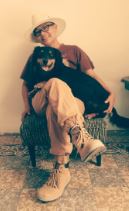
The following is my translation of a story by Isis Samaniego, with their permission. Samaniego is a writer based in Puebla, Mexico and originally from Veracruz. They founded the publishing house, Ediciones Ají, and have published numerous books of stories and poems. The below story is part of a collection that make use of older tales and myths to then reflect on the current world.
Clementiae
Amid a frozen landscape, icicles adorned the entrance to the cave like soldiers in a line, giving the place a grim appearance. Above, the mountain offered a steep and violet grimace. At the start of the path, there was the river. Old man Charon read poetry to pass the time. For him, it was always the same; an eternity of waiting for some worldly soul to lose their way.
Times had been bad; days had passed without anyone bothering to die. With a gaunt and drowsy face, he set aside the book he had been reading. He wiped his eyes, rubbed them again, and sharpened his gaze. Something was moving off in the distance, but the thing was so tiny that he couldn’t make out what it was. He scratched his head and rubbed his eyes once more.
“Hmm. What could this thing that moves so slowly be? Hopefully, it’s a charitable soul come to take pity on this tedium that is consuming me.”
Troubled by the tardiness of that soul, he began to prepare his boat and oar, polishing them with a piece of linen. He cleared away the cobwebs that had started to deface his vessel. He swept off some of the eternal dust that constantly fell from the grey sun, which so tarnished this land. The aforementioned thing was approaching slowly, and he was already rubbing his hands and beard with a hint of uncertainty.
“Who could it be? Surely not a restless soul! Those ones are always in a hurry to reach purgatory and settle their debts,” Charon muttered to himself.
Finally, after polishing his austere boat with a little whale grease, he got ready, united the rope from the dock, and set out on the water to meet the thing.
On the other side, something resembling a helmet got closer and closer, though its colour was indistinguishable. It moved slowly and heavily, leaving behind a faint trail of small clover-like imprints in the sand. It paused to rest, as if its load was a burden, an impediment to reaching paradise.
Out on the river, Charon stopped rowing and once more picked up his timeworn book, reading and rereading complex texts that not even the gods could decipher these days: Aestus clamare a caelum multa nocte, exitium, aestus clamare a caelum multa nocte, exitium (1). He repeated the phrase as though it were a prayer. Like that he could reassure his conscience that he was doing what was right. After a few moments, he resumed rowing, murmuring again that phrase that sustained him through his dark and tedious life of waiting in this desolate steppe.
On the other side, the figure began to move faster—two steps, then a rest, two steps, then a rest—until it found a halting rhythm. Then its movement became awkward and creaking. There was a certain sluggishness in the way the thing moved, now without stopping. The old man’s eyes lit up—at last, the daemon was approaching. But the closer it got, a putrid stench spread through the already heavy air, unsettling even the most scornful, and permeating everything.
“By all the gods! What a foul stench! Who dares to bring such pestilence to the entrance of the realm? The dead arrive covered in camphor salts, bathed in lavender water, and wrapped to contain their miasmas. Who would attempt such an audacious intrusion?”
Within minutes, the source of the stench reached him. But it was not a man, woman, or child. It was…
“It’s you, my great friend Cheledonio! The mightiest of hard-shelled reptiles with a black dome. What brings you here?”
“I come to see the great Zeus, or some other god, that can reduce my shame and discomfort with humankind! I am not dead, but nearly so. I am endangered by these individuals, misfortune thrives in the seas. Humans show no respect for animals, whether of the land or sea. They are destroying plant life and countless creatures of this world. It is inconceivable that their highest creation is laying waste to everything placed upon the earth, the sea, and the air! I come to denounce their greed, ambition, and exploitation of the world. I am old, and I will soon die. Perhaps this is my final journey, because I am tired of consuming their garbage and contamination. I come to ask for clemency of the great father. Who but him ordered their creation, so we then have to protest the vandals he has made—those who risk destroying the entire world as we know it. I hold that this creature of flesh and bone, made in his likeness, has plundered us without shame or moderation. I am so tired! My home is no longer the earth; I stand at the threshold of the Elysian Fields.”
With that, and with great effort, Cheledonio, the great turtle, stopped breathing.
Note: On the morning of September 23, 1988, the body of a leatherback turtle (D. coriacea) was found washed ashore on the beach in Harlech, Gwynedd, United Kingdom. It was initially believed to have died of old age, as it was discovered intact among the dunes. However, an autopsy revealed its stomach contained more than half a dozen PET bottles, and its intestines were clogged with plastic bags, which impeded its liver function. This was presumed to be the cause of its death. The turtle weighed nearly a ton, with a shell measuring 2.91 metres in length and a flipper-to-flipper span of 2.77 metres. Carbon-14 testing estimated its age to be approximately 500 years.
(1) The air clamours for the sky in the middle of the night, nothing.
 resistance words