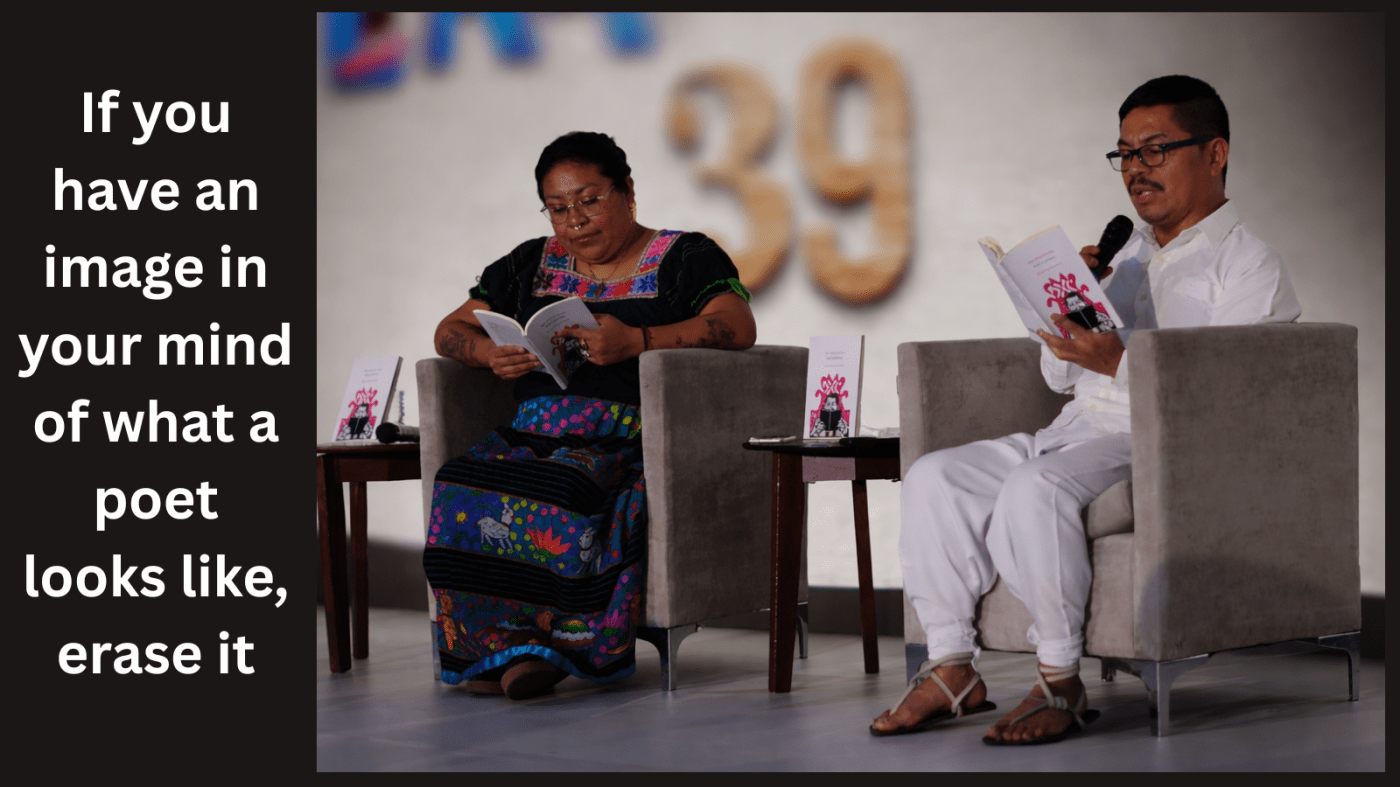
I stumbled upon Manuel Espinosa Saino’s reading of his latest collection of poetry as I was wondering a book fair in Puebla.
“Mis muertos son amorosos, hasta eroticos,” he was saying; “My dead people are loving, even erotic.” He contrasted his dead people with the zombie movies of the West, where the dead — instead of bringing wisdom and memories — are something to be feared.
He read out various poems, first in Totonac, then in Spanish. I prefer to read poetry than listen to it, but this time I stayed for one after another.
Espinosa, a journalist and poet from the Ixtepec, in the Sierra Norte mountains of Puebla, said he couldn’t help but write about love and about eroticism. A man in the audience who was also from the Sierra Norte stood up to ask a question – “We’re often seen as quite reserved people, were you worried about how your poetry would be received?”
“I was a little bit worried, but because there was so little erotic and sensual Totonac poetry, I felt there was a need, and to my surprise, it was taken very well,” Espinosa replied.
Intellectual leadership is a white males’ club. The so-called “classics” of poetry and literature are almost exclusively limited to white males, and to the Global North. Geopolitical experts are while, male, and in the Global North, and even research studies are disproportionately run and written by the self-agrandising club, with its connections, privilege, power, and wealth.
The best poetry though, isn’t a performance. It’s brave, authentic, feeling, and excruciating creative. It is bits of soul, painted out in word shapes. It captures life fragments at their rawest. As Roque Dalton wrote, “Creo que el mundo es bello, que la poesía es como el pan, de todos” – “I think that the world is beautiful, and that poetry is like bread, belonging to everyone.”
Poems by Manuel Espinosa Sainos, which I’ve also translated from Spanish to English:
| Lilhka’ Xtachaná mpala paks lipatsankgayaw ntiji’ kintankgaxekgakán, kintachiwinkán, kinkilhtsukután, nimakgantuxtí xtamalaknún kimpuchinikán maski tlakg anán liwat xakilhtutu’, nimakgantuxtí. Lakgkurus ya ntasiyú ntalimaxkgat, talipuwan, talhkatawalanit kkakukuni’xtantun tatsinksat. Lu nipaxawá skgolí wun, na nikatsí taní na an, lakgsputtilha xatachiwín kilatamatkán, lakgsputtilhá, maski lu makgasá tsokgsamaw, maski laxakgatlipatanaw, niamalakgsputuyaw wantu kinkamapitsiyán. | Fronteras Parece que todos los caminos conducen al olvido, a perder nuestras raíces, nuestra lengua, nuestra esencia, a lo lejos, la abundancia es la promesa de un dios que miente. La pobreza es una cruz que viste el paisaje, el hambre una hilera de huellas en la arena. Desorientado, el viento silva una profunda soledad mientras se desvanece el eco de nuestra historia, parece que en vano, sí, en vano hemos vivido rascando la pared que nos divide. | Borders It seems that all roads lead to oblivion, to losing our roots, our language, our essence, and eventually, abundance which is the promise of a god who lies. Poverty is a cross that clothes the landscape, hunger is a row of footprints in the sand. Disoriented, the wind whistles a deep loneliness while the echo of our history fades away, it seems that in vain, yes, in vain we have lived scratching at the wall that divides us. |
Litaniy chiyat Tlan naklichiwinán pi lakum chuchut latapuliy kkakiwín kilakgastapu wakxilhkgoy nixaxlikana kiwi, ni xaxlikana xtiki, nixaxlikana akgatawan. Tlan naklichiwinán pi snun k akgatapulh, pi xtalhtsi jaka litaxtulh ki nakú, pi latsukat klitaxtunit ktastiwitnawaka k akgalaxax, pi nikkanalaniy maski nawakán pa’pa. Tlan naklixapay kilakgastapu, ki makanín, kin kankán, kin tekgán chu kinkilhni xa xlikana talhtsi tu tamakganít kkatawán. Tlan nixawá lakum chichí nak kgankgawanán tu kilhtanupat mintakgsanín, tlan nakxkay mintakuwaní, milakgaspatpu, mintamputsni, minkilhpín, lata nakliniy chiyat, k kilhtanuma milukut nakkgalhxtatamay. | Morir de rabia Soy capaz de decir que mis ojos agua de río transitan por los viejos montes y miran falsas arboledas, grillos imaginarios, ramas ilusorias. Soy capaz de decir que me tatué un silencio en el oído, que mi corazón es un hueso atorado en el mamey, que soy un beso colgado entre las ramas del naranjo, y que no me importa cualquier eclipse de luna. Aniquilar con la mirada, con el tacto, con el olfato, con el oído y con el gusto cualquier semilla verdadera arrinconada en las hojarascas. Soy capaz de oler más que el perro cualquier mentira enredada entre tus dientes, ladrar tu nombre, tus ojos, tu ombligo, tus labios, hasta morir de rabia, babeando, con tu hueso en el hocico. | To die of rage I am able to say that my eyes river water travel through the old hills and look at fake groves, imaginary crickets, illusory branches. I can tell you that I tattooed a silence in my ear, that my heart is a bone stuck in a mamey, that I’m a kiss hanging in the orange tree branches, and I don’t care about any lunar eclipse. To destroy with a look, with touch, with smell, with hearing, with taste any real seed shoved aside into the dead leaves. I can smell better than a dog any lie tangled up in your teeth, bark your name, your eyes, your belly button, your lips, until I die of rage, drooling, with your bone in my mouth. |
 resistance words