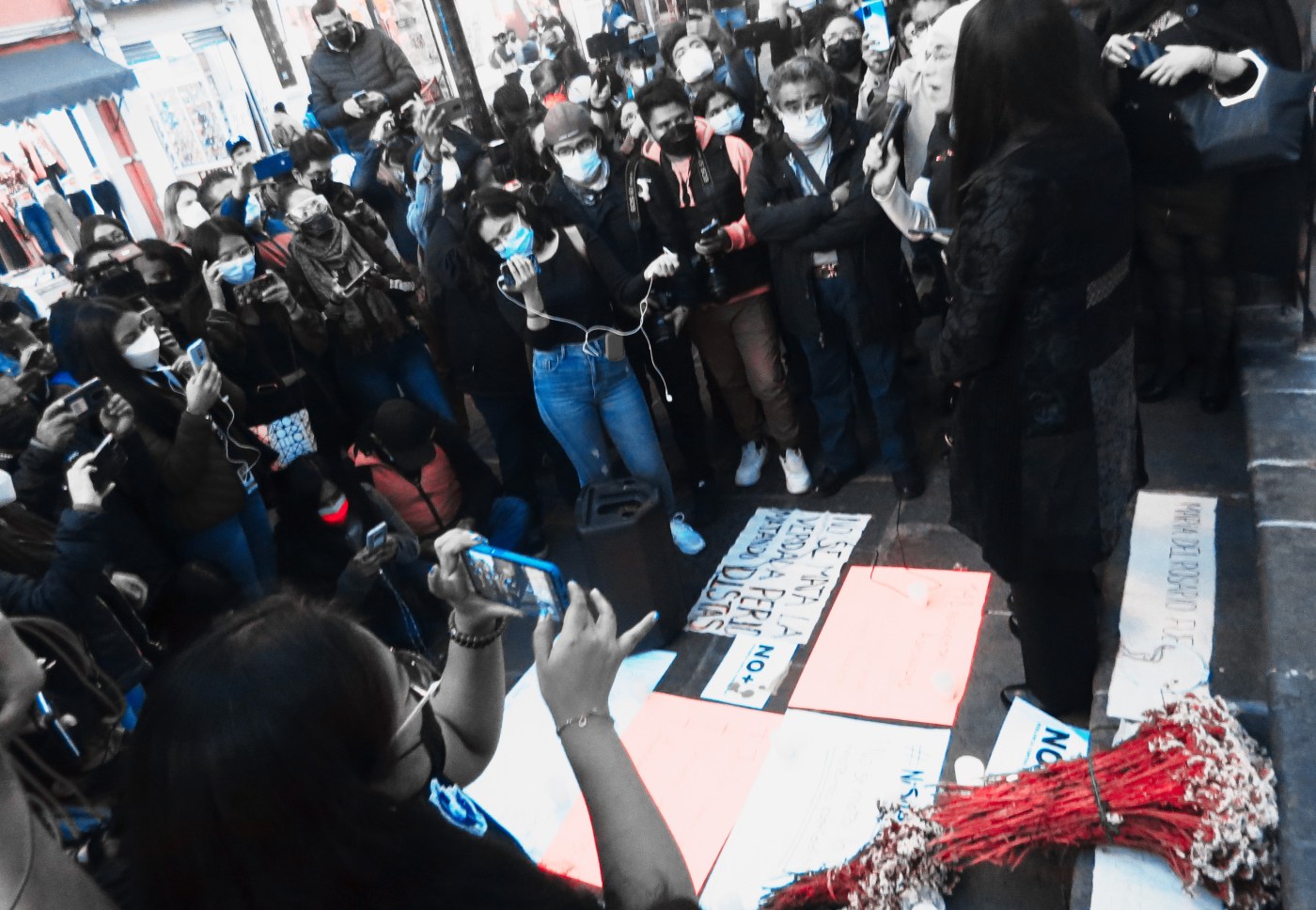
I pace my small apartment for almost an hour after interviewing a fellow journalist in Mexico who was kidnapped by organised crime groups. Another day, a source has been arrested, another dies in a suspicious car accident. Others tell compelling stories of saving rivers and stopping powerful corporations. I feel alive when I work. But often also worried, deeply sad, and overlooked.
I also work as a global features editor, and the news comes in throughout the day, announcing more horrific events. Another oil spill, more destruction of the environment, of cultures, of people’s
youths and their futures. Committed with such impunity, it leaves me questioning, sometimes, the impact of this work. The repetitive and ongoing nature of such injustice can also make it feel routine and close to pointless.
These are tough times for both people reading or listening to the news, and for those creating it (the real journalists who challenge economic and political power rather than aligning with it). But we must continue to stay informed—ignoring the bad news won’t stop it.
And amid this, while courageous journalism is needed more than ever, it is instead being smothered as social media, search engines, and the web are being increasingly enshitified — inundated with advertising, incorrect information, AI’s delusions, and mundane, vacuous viral videos.
It is an information crisis and a justice crisis all at once. But just as overconsumerism and the 48,000 overflowing landfills and dumpsites across the world are a clear call to only use what we actually need, these crises also embody within them a call for deep change, for a reckoning. AI dominance begs us to return to everything that is humanising, creative, and real. Injustice and climate call for structural action and a strengthening of good journalism. The mainstream outlets beholden to corporations and in denial of empire and inequality are increasingly obviously, useless.
News priorities
Media outlets and other sources of information, like search engines and social media, are skewing perceptions about what matters. The amount of attention and space given to different regions, issues, and people forges a hierarchy of concerns. Issues covered tediously can risk desensitising, normalising, numbing. But overlooked news and silence numbs in malevolent and long-lasting ways, infusing populations with extremes of tolerance and deflection. Mass hunger in a world that produces an excess of food seems to me a raging nightmare, deserving of daily coverage and strike action until it ends. Yet most people are accustomed.
But for the journalists and outlets with integrity, at times it can feel like there is nothing left to say; that we’ve reported the injustices over and over. That all we are doing is documenting how the house is falling apart. It is indicative of a need to take things to the next level.
So how do we do good journalism, when everything is at stake and none of the polluting and warring criminals are held accountable? How can our news reading and news producing be useful, even as long-term worry exhausts us and narrows cognitive flexibility and creativity. How do we ensure clarity and care, without also falling apart?
Enshittification
Add to that, the addictive algorithmic boosting of low-grade and commercial content, and the burying of critical insight and investigation. Amid catastrophe, injustice, and repression, the key sources of information — rather than enlightening — are calculated to numb and dull people.
The social media, information, book, and media landscapes are rapidly deteriorating as ad load is growing to ridiculous amounts. Every other post is sponsored content, online recipes and articles can be unreadable without a browser or tools that remove all the ads. Our feeds are industrial swamplands of sponsored content and viral AI videos and AI stories. And for some demographics, objectified images of women.
Even newsletter spaces like Substack boost privilege (almost all the top newsletters are by men) and profitability, and AI search engine summaries are discouraging direct reads of alternative media outlets. First page search results are likewise dominated by corporations like Expedia, US outlets (even for users who aren’t there), and mediocre click-bait websites. It’s hard to compete, and our in-depth reporting can feel like feeble feathers in a hurricane.
Further, people expect shorter and short content. Two minute videos are too long now. All the scrolling and short formats promote habits and standards that reject complexity, discomfort, intention, depth, process, and contemplation, and instead—especially when combined with e-consumerism—a desire for instant results is fostered.
Opportunities and actions
Algorithmic curation and content recommendation based on predicted interests is understandably tempting for people who are overworked and exhausted. Intentional decision making is a mental load after a long day of work, caring for others, dealing with bureaucracy or discrimination, or working through trauma. But being selective about news, information, and entertainment is practically a radical act amid such a deluge of crap and with companies like Meta supporting the right and suppressing alternatives and resistance (e.g. Brazil).
Intentionality is particularly necessary for international news, where regions like Latin America, Africa, and Asia have to wrestle for relevance in a rigid hierarchy of life that ranks them lower. Injustice here must be hundreds of times worse to capture interest. Indigenous towns drone bombed and eliminated aren’t interesting enough. The recent gold mine collapses in Sudan, the millions forcibly displaced there, barely register.
Readers and reporters can gain back some control over their local and international news consumption with scheduled news time and short lists of strong pro-people, pro-planet media outlets and newsletters like mine, Excluded Headlines, which seek to re-balance world news coverage.
Well-written or produced news is actually good for us. It orders the chaos and gives it meaning. Depth and clarity around the causes and forces behind the horror is important for knowing how to put out the fire, as well as for our own well being and for informing our collective decision making. Good journalism also restores a sense of freedom and relief after all the enshittification. It reminds us that not everything is garbage.
Avoiding the bad news won’t help with handling reality. But type of awareness matters, and a profound awareness of global and local forces is important for countering isolation, for experiencing the patterns as history takes place that reveal connectedness between issues, resistance, and events, and for never falling into the trap of tolerating harm. On the other hand, the banking system of education, AI, and low-quality media, by fostering an inability to think critically and under-representing oppressed peoples, can strengthen systemic class, race and nationality, gender, sexuality, and disability violence.
Hence, media and information isn’t a side note to life, it is decisive. And the best journalism isn’t done from the sidelines, but from the battlegrounds and fields. Parachuting into another country or into an issue to cover them doesn’t work. Reporting from a couch or a mansion, from the pinnacles of privilege, and from the corporate headquarters of empires isn’t journalism.
We need reality — raw, and decoded. Not greenwashing, not whitewashing, not spinning away the injustice, sugar-coating disregard and cruelty, justifying the intolerable, naive glorifying of rightwing forces in Global South countries, platitudes of balance and neutrality from outlets very much aligned with corporations and euro or US-centric and pro-war perspectives.
Interestingly, despite the glut, most people do recognise climate change as serious (86% globally), for example. And that is where the hope is. About 56% of people think about climate change on a daily or weekly basis, and a poll of some European countries found 77% of respondents believe companies should be held responsible for environmental harm.
The difficult next step is facing up to the fact that protecting the environment and building true global equality and justice involve some discomfort and uncertainty. Tweaking shower times and donating to charities won’t cut it. Ending societal and structural addictions to petroleum involves effort, confrontation, and deep change.
The task is to imagine, act, and change
Amid the oil spills and bombs, it can be hard to dream. Here in central Mexico, with organised crime controlling streets, transport, extorting, forcibly disappearing, and tainting the air with tension and fear, it feels close to impossible to imagine building some kind of nurturing community on these bruised and sunken streets. Yet we have to. We have to conjure up hope from the fish-scale-clogged drains and the potholes of life.
We have to free our imaginations from the bare and boring rooms of AI and 3 a.m. social media scrolling so we can remember the kite sky parties, the marigold fields, the precious art galleries in Havana overlooking the bay, the rainbow beetles and stealth caterpillars and mulberry silkworms that turn saliva into silk. Like magic. We’re magical too, but we often forget it. Our ability to turn the ordinary into the extraordinary is there, if dusty and atrophied.
I asked a few activists here if I should write another novel. “Is there any point?” I said, discouraged. Things feel too urgent for novels and stories and art. It is a time for strikes, roadblocks, shutting down and building anew. But they said yes, and of course one can do both.
“The harder times are, the more necessary art and creativity is. It provides hope, it keeps us humanised and sensitive to others,” replied one friend. So, I’ve started writing another novel and it is pouring out of me. It will be the messy story of how people do away with borders, global inequality, environmental pillaging, and empire and build something more caring and nurturing than this selfish nightmare.
The boom of AI is asking us what it means to be human. That question about our collective identity couldn’t have come at a better time. We should refuse AI—not because technology is bad (it isn’t) but because of who owns it and how they have looted our intellectual work to control what we know and how we think. Build shields against the devaluing of life, of our work, of creativity. Turn AI off in search engines or use operators like -AI in searches (and other operators like site:.co to force results from a particular country rather than almost exclusively the US). Boycott corporate media and use search engines that are more neutral than Chrome like Mojeek (less big business but still very Eurocentric), Brave, and Qwant.
AI and billionaire-controlled social media, through the proliferation of so much AI-generated content and unverified or incorrect information, are planting distrust and disillusionment, I mentioned to my friend.
“Exactly. AI takes away critical thought and dehumanises, and technology is inundating us so we don’t feel the loss. When we’re overstimulated, we don’t pay attention to anything,” she said.
Our attention is everything right now. It is accountability and it is priorities. The news is hard to read, but don’t stop. Just be strategic and selective. Let it connect and ground us, and inspire us. There is so much bravery, beauty, kindness—and therefore such potential. Some media outlets will overlook that, others will highlight the resistances and generosity.

